History
Monument Valley and the Navajo Nation: History, the Tribal Park and the Diné Today
Monument Valley lies inside the Navajo Nation, and its story is a Navajo story. The Diné, as the Navajo call themselves, know the valley as Tsé Biiʼ Ndzisgaii, usually translated as “valley of the rocks”, and consider it sacred. Navajo families still live in and around the valley. Since 1958 the heart of the valley has been Monument Valley Navajo Tribal Park, created by the Navajo Tribal Council and run today by the Navajo Nation’s own Parks and Recreation Department. It is not a national park, and national park passes are not accepted.
To understand what you are looking at from the visitor center, it helps to know the longer history behind it: the people who lived here before the Diné, the Diné homeland marked by four sacred mountains, the catastrophe of the Long Walk and the 1868 treaty that brought the people home, the trading posts and film crews of the twentieth century, and the Nation’s decision to protect the valley as a tribal park. This article draws on the Navajo Nation’s own sources first, the Navajo Tourism Department and the Navajo Parks and Recreation Department, with settled history from other references, and ends with how to visit with respect.
Monument Valley and the Navajo at a glance
- Navajo name: Tsé Biiʼ Ndzisgaii, which the park writes Tse’Bii’Ndzisgaii.
- Who manages it: the Navajo Parks and Recreation Department of the Navajo Nation.
- Since when a park: 1958, when the Navajo Tribal Council established the tribal park.
- Size: 91,696 acres, spanning Utah and Arizona, at 5,564 feet above sea level.
- The Navajo Nation: about 27,000 square miles, the largest Native American reservation in the United States, with its capital at Window Rock, Arizona.
- Status: sovereign tribal land; the park is not a national park and does not accept national park passes.
- Who lives here: Navajo families, on their homesites across the reservation; visitors are guests.
The name: Tsé Biiʼ Ndzisgaii
The English name describes the formations as monuments. The Navajo name describes the place as a valley among rocks. The tribal park’s own page gives it in the form Tse’Bii’Ndzisgaii, alongside its English name, and the valley is widely glossed as “valley of the rocks”.
The difference matters: for the Navajo Nation the valley is more than scenery. The Navajo Parks and Recreation Department states that all Navajo Tribal Park scenic areas are considered sacred sites and are protected by Navajo Nation law, and asks visitors not to climb the monuments, sacred sites or buttes. Keep that in mind as you read the names on the park map.
Before the Diné
People have moved through this country for a very long time. The Navajo Tourism Department’s history page says that, according to anthropologists and historians, Ice Age Paleo-Indian hunters (12,000-6,000 B.C.) roamed the Monument Valley area, followed by archaic hunter-gatherers (6,000 B.C.-1 A.D.).
After them came the Ancestral Puebloans, the farmers of the Four Corners who built in stone. The same page says evidence of the Ancestral Puebloans in Monument Valley is still visible through their sites and ruins, dating from before 1300 A.D. Those sites are protected. Visit Utah reminds visitors that removing pottery or other artifacts is a violation of federal law, and the tribal park’s rules forbid disturbing or removing plants, rocks or artifacts.
The Diné homeland and the four sacred mountains
The Navajo Tourism Department, writing in the Diné voice, says that centuries before Christopher Columbus landed in the Americas in 1492, the tribe was settled in the Four Corners area of the Colorado Plateau. In Diné oral tradition, the people came to their homeland by emerging through four levels of worlds into this world, the Glittering World.
The homeland is bounded by four sacred mountains. Discover Navajo’s culture pages, written by Ray Baldwin Lewis, explain that the Holy People placed them in four directions:
- East: Mt. Blanca, associated with White Shell.
- South: Mt. Taylor, associated with Turquoise.
- West: San Francisco Peak, associated with Yellow Abalone.
- North: Mt. Hesperus, near Durango, Colorado, associated with Jet Black.
The number four runs through traditional Navajo philosophy, the same pages explain: four directions, four seasons, the first four clans and four colors. The Holy People taught the Diné to live in harmony with Mother Earth, Father Sky and every living thing, and there are more than 50 kinds of ceremonies to restore that balance, some lasting several hours, others as long as nine days.
Spaniards, raids and the road to war
The Navajo Tourism Department dates the first Spanish contact with the Diné to 1581. In their homeland the Navajo built houses, planted crops and raised livestock, and their country passed from Spanish to Mexican claims and then, in 1848, at the end of the Mexican-American War, to the United States.
Settlers pushed into Navajo country, and in August 1851 the U.S. Army established Fort Defiance, near present-day Window Rock, Arizona. Raiding went both ways, and Ute and New Mexican slavers took a large number of Navajo people captive and sold them. In the years that followed, the U.S. government decided to remove the Navajo from their homeland altogether.
The Long Walk and Hwéeldi
In January 1864 Colonel Kit Carson launched a full-scale assault on the Navajo. His troops used a scorched earth policy: hogans were burned, livestock killed and irrigated fields destroyed, until starving families had little choice but to surrender. The people were then marched east across New Mexico to the Bosque Redondo, a camp beside Fort Sumner on the Pecos River, a place the Navajo call Hwéeldi.
This was the Long Walk. Historians count some 53 separate forced marches between August 1864 and the end of 1866. In all, 10,000 Navajos and 500 Mescalero Apache were forced into the camp. Between 8,000 and 9,000 people were held on an area of about 40 square miles, with a peak of 9,022 by the spring of 1865. Crops failed year after year, the water was poor, and up to 3,500 people died from starvation, disease and executions over a four-year period.
Not everyone was captured. Some Navajos refused to surrender and scattered to Navajo Mountain, the Grand Canyon and parts of what is now Utah. Visit Utah’s own short account of the period says the attempts at forced relocation ultimately failed.
For Diné families the Long Walk is not distant history. Accounts of it have been handed down from grandparents to grandchildren, and many were gathered by Navajo Community College Press in Navajo Stories of the Long Walk Period, published in 1973.
The 1868 treaty and the return home
The Treaty of Bosque Redondo was concluded at Fort Sumner on June 1, 1868. It created a reservation, and the Navajo walked home to their own country. That is rare in the history of the United States: the Navajo Nation is one of the few reservations whose lands overlap the nation’s traditional homelands.
The first reservation of 1868 covered about 3,300,000 acres. It grew in a series of additions and reached its present boundaries in 1934. Today the Navajo Nation covers about 27,000 square miles across northeastern Arizona, northwestern New Mexico and southeastern Utah, the largest Native American reservation in the United States. Its tribal council dates from 1923, and its capital is Window Rock, Arizona. In 2020 the Nation counted 399,494 tribal members, more than any other tribe in the country.
Trading posts and the Gouldings
In the decades after the treaty, trading posts became a link between Navajo families and the wider economy. In the early 1920s Harry Goulding and his wife Leone, known as “Mike”, settled in Monument Valley to open a small trading post. Their own history says they lived in tents at first, trading food and supplies with the local Navajo community in exchange for handmade jewelry and rugs.
The permanent stone trading post was built in 1928, seven years after Harry Goulding bought 640 acres in the area, according to its listing history. It still stands as the Goulding’s Trading Post Museum, and it was added to the National Register of Historic Places on October 20, 1980.
Navajo weaving was, and is, central to that trade. Discover Navajo explains that Navajo women believe weaving was taught by Spider Woman, and that distinct regional styles grew up across the Nation: Two Grey Hills, Ganado, Teec Nos Pos and Crystal among them.
Hollywood arrives
According to Goulding’s own history, during the Great Depression the Gouldings traveled to Hollywood with only $60 to show Monument Valley to the film industry, and their perseverance brought director John Ford to make Stagecoach, starring John Wayne. Goulding had photographed the valley and sent the pictures to Ford, who went on to shoot not only Stagecoach (1939) but several other Westerns there.
The films made Monument Valley famous, and Goulding, seeing the value of tourism, added lodging and other services. Goulding’s says it worked closely with the local Navajo community as the trading post grew into a hub for travelers, film crews and artists. But the Westerns also told a story about Native people that the Diné did not write: Stagecoach, like most Westerns of its era, has been criticized for depicting Native Americans as mere savages, while Navajo land filled the screen. Our article on Monument Valley in the movies covers the films and their locations.
Uranium and the Code Talkers
Two other twentieth-century stories touch the valley. Between 1945 and 1967 the southern part of the Monument Upwarp, the geological structure under the valley, was mined for uranium, with vanadium and copper found alongside it in some deposits.
Earlier, during the Second World War, Navajo Code Talkers served in all six Marine divisions from 1942 to 1945, sending tactics, orders and battlefield information by radio in the Diné language. Discover Navajo records the saying that without the Code Talkers the Marines would never have taken Iwo Jima.
Founding the tribal park in 1958
As visitors kept coming, the Navajo Tribal Council turned the heart of the valley into a park of its own. Visit Utah records that Monument Valley Navajo Tribal Park was established by the Navajo Tribal Council in 1958, and it now spans 91,696 acres inside the Navajo Nation along the Utah-Arizona border.
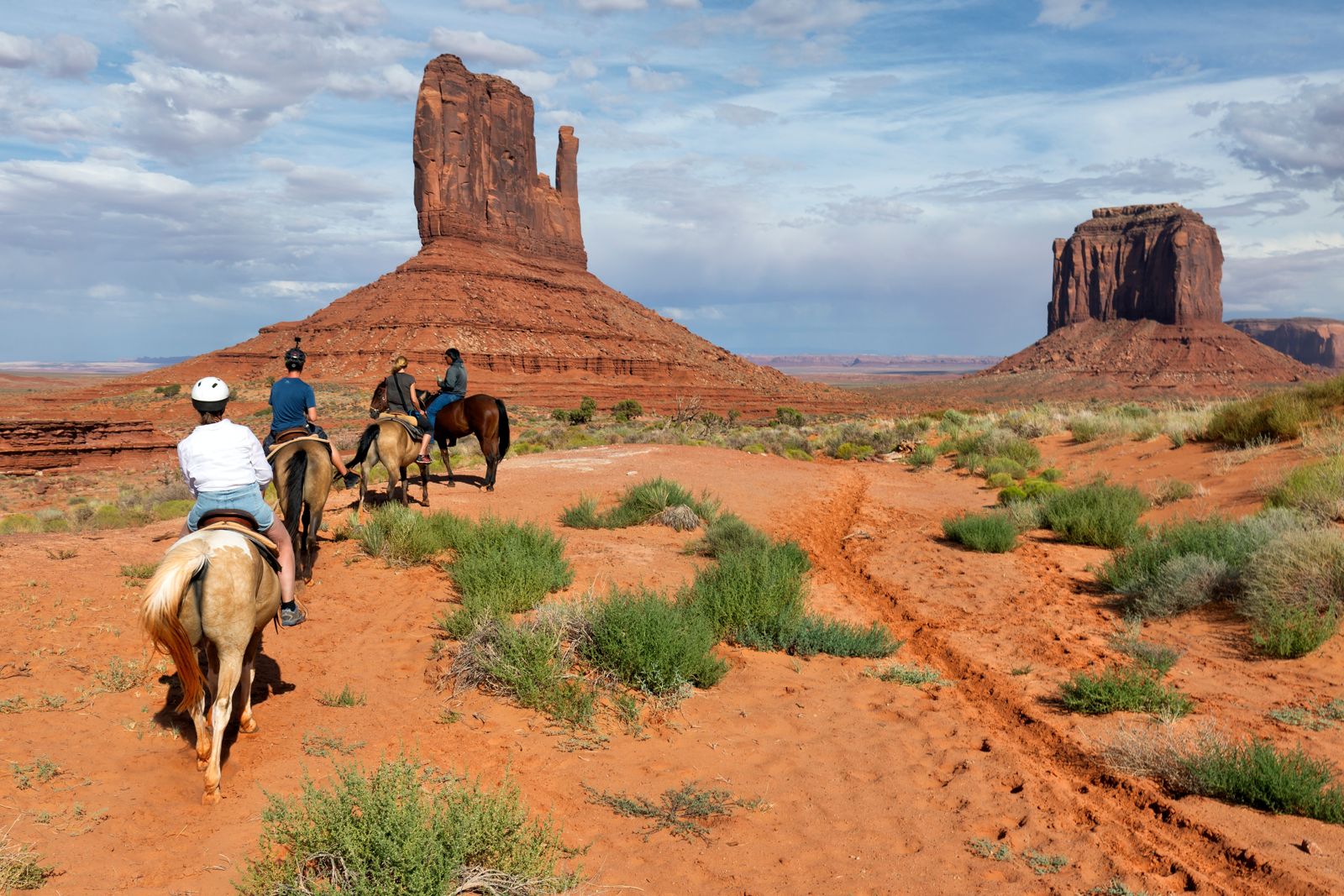
The park works differently from a national park. Entry, permits and rules are set by the Navajo Nation. Most backcountry and off-road travel is prohibited unless you are with a licensed Navajo guide, and places such as Ear of the Wind can only be reached on a guided tour with Navajo tour operators. The tours themselves are a Navajo economy: guided trips by vehicle and on horseback, led by local Navajo guides, and vendors along the loop road selling hand-crafted jewelry and food direct from the artisans.
In 1986 the Navajo Nation Council also set up the Navajo Tourism Department, which runs Discover Navajo, to promote tourism as an economic development initiative on the Nation’s own terms.
Goulding’s returns to Navajo ownership
The trading post that brought Hollywood to the valley has come full circle. In November 2023 the Navajo Nation bought Goulding’s Lodge for $59.5 million. Goulding’s now describes itself as continuing its legacy under Navajo Nation ownership, welcoming guests with Diné hospitality.
Together with the tribal park, that means the visitor center, the Valley Drive, the guided tours and the oldest lodging in the valley are all now in Navajo hands.
The hogan
On a guided tour you may be invited into a hogan, the traditional Navajo home. Discover Navajo describes it as a sacred dwelling: shelter, protection, home and refuge. The roof is in the likeness of the sky, the walls stand like the mountains and trees around it, and the earthen floor is always in touch with Mother Earth. When a hogan is finished, a medicine man blesses it.
A few things to know:
- The door faces east, to welcome the morning sun.
- Two traditional forms: the older forked-stick or “male” hogan, cone-shaped and used mainly for ceremonies, and the larger “female” hogan, round or many-sided, that served as the family home. From the 1900s, families began building six- and eight-sided hogans, partly from railroad cross-ties.
- Moving inside: Discover Navajo asks that you walk in a clockwise direction, and never enter or leave counterclockwise.
- Staying overnight: some Navajo families host visitors in a traditional eight-sided, one-room hogan, with no electricity or running water.
- Stories have seasons: winter is the traditional time for storytelling, and the coyote stories are told only in winter.
Visiting with respect
The Navajo Parks and Recreation Department tells visitors that, by an enduring Navajo custom, visitors are always treated as honored guests and offered shelter, warmth and nourishment. The courtesy runs both ways. Visit Utah puts it plainly: you are a guest on the reservation and tribal park land, allowed there with the permission of the tribe.
The tribal park’s rules, in brief:
- Ask before you photograph people. Get permission before taking pictures of Navajo people, and do not wander into residential areas or disturb property. Many Navajo families still live on the reservation.
- Do not climb. Climbing and BASE jumping are prohibited, and the park asks visitors not to climb the monuments, sacred sites or buttes.
- No drones. Drones are prohibited on the Navajo Nation.
- No alcohol. Alcohol and illegal drugs are prohibited on the Navajo Nation.
- Take nothing. Do not disturb or remove animals, plants, rocks or artifacts.
- Stay on the route. Keep to the designated road and trails, and hire a Navajo guide to go further.
- Commercial photography and filming need a Special Use Permit from the park.
Buying from the vendors along the road, booking a Navajo-owned tour, and eating at Navajo businesses are simple ways to make sure the money you spend stays in the valley. Our tours page lists guided options with Navajo operators.
Living culture beyond the valley
Monument Valley is one corner of a large Nation. Every first week of September, the Navajo Nation Fair in Window Rock, Arizona, brings an All-Indian Rodeo, Navajo song and dance, a contest powwow and the Miss Navajo Nation Pageant. Discover Navajo’s culture pages describe traditional dress, silversmithing and weaving as living arts, and the medicine man as the keeper of the people’s history and ceremonies.
A guide who explains the names of the rocks, or a weaver selling at the roadside, is part of that living culture, and the best way into it.
Frequently asked questions
Is Monument Valley a national park?
No. It is Monument Valley Navajo Tribal Park, established by the Navajo Tribal Council in 1958 and run by the Navajo Parks and Recreation Department. National park passes are not accepted.
Who owns Monument Valley?
The valley lies within the Navajo Nation, a sovereign nation within the United States. The tribal park covers 91,696 acres across the Utah-Arizona line, and since November 2023 the Navajo Nation has also owned Goulding’s Lodge.
What does the Navajo name for Monument Valley mean?
Tsé Biiʼ Ndzisgaii is usually translated as “valley of the rocks”. The Navajo Nation considers the valley sacred.
Do Navajo people live in Monument Valley?
Yes. Navajo families live on homesites in and around the valley, and the park asks visitors to respect their privacy, stay out of residential areas and ask before taking photographs.
What was the Long Walk?
The forced removal of the Navajo from their homeland to the Bosque Redondo at Fort Sumner, New Mexico, beginning in 1864. Up to 3,500 people died before the Treaty of June 1, 1868, allowed the Diné to return home.