Culture & film
Forrest Gump Point, John Ford's Point and Monument Valley in the Movies
Forrest Gump Point is the pullout on U.S. Route 163 in Utah, around mile marker 13, where Tom Hanks’s Forrest Gump stops running in the 1994 film and the road runs straight ahead toward the buttes of Monument Valley. It costs nothing to stop: it is a pullout on a public highway. John Ford’s Point is the other famous film spot, a viewpoint inside Monument Valley Navajo Tribal Park, on the Valley Drive, named for the director who made the valley the face of the Western.
Between them sits a story that runs from a trading post in the 1920s to Hollywood studios, through John Wayne’s rise to stardom, to a highway that has been filmed so often it feels familiar on first sight. This article covers how the films came to Monument Valley, which classic Westerns were shot here, the formations you will recognize, what Forrest Gump Point and John Ford’s Point are like today, and how to see them safely and respectfully on Navajo land.
Monument Valley on film at a glance
- First big film: John Ford’s Stagecoach, released March 2, 1939, with John Wayne.
- Who brought Hollywood: Harry and Leone “Mike” Goulding, traders who settled in the valley in the early 1920s.
- Ford’s valley Westerns include: Stagecoach (1939), My Darling Clementine (1946), Fort Apache (1948), She Wore a Yellow Ribbon (1949) and The Searchers (1956).
- Later films include: Once Upon a Time in the West (1968), Forrest Gump (1994) and The Lone Ranger (2013).
- Forrest Gump Point: U.S. 163 near mile marker 13, Utah; GPS 37.101445, -109.990812, according to Visit Utah.
- John Ford’s Point: on the 17-mile Valley Drive inside the tribal park.
- Filming today: commercial photography and filming need a permit from the Navajo Parks and Recreation Department; drones are prohibited on the Navajo Nation.
A trading post and $60
Monument Valley reached the screen through a trading post. Goulding’s own history says the business began in the early 1920s, when Harry Goulding and his wife Leone, known as “Mike”, settled in the valley to open a small trading post, living in tents and trading food and supplies with the local Navajo community for handmade jewelry and rugs. Their stone trading post was built in 1928, seven years after Harry Goulding bought 640 acres nearby.
During the Great Depression, the Gouldings went to Hollywood with only $60 in their pockets to introduce the valley to the film industry. Harry had photographed Monument Valley and sent the pictures to John Ford, who was looking for a location for a new Western. Goulding’s says it was this perseverance that brought Ford to make Stagecoach, starring John Wayne. Visit Utah sums up the result: after Stagecoach (1939), the trading post became a key location for Hollywood Westerns, and the valley became the symbol of the West.
Stagecoach, 1939
Stagecoach was the first of many Westerns John Ford shot in Monument Valley. Conditions were hard. The crew was billeted in an old Civilian Conservation Corps camp in Kayenta, Arizona, and at the 5,700-foot elevation it faced constant strong winds and low temperatures. The location work took place near Goulding’s Trading Post, about 25 miles from Kayenta.
The finished film mixed shots of Monument Valley with scenes filmed on ranches in California, so the geography does not always add up. That did not matter to audiences. Stagecoach was released on March 2, 1939, was praised at once by critics, and made John Wayne an A-list leading man. Ford was nominated for the Academy Award for Best Director, and in 1995 the film was selected for the National Film Registry.
It also carries a hard legacy. Like most Westerns of its era, Stagecoach has been criticized for depicting Native Americans as mere savages, in a valley that was, and is, Navajo land.
Ford’s favorite location
John Ford came back again and again. Monument Valley became his favorite location for Westerns, even though it was rarely the right place geographically for his plots. He used it for:
- My Darling Clementine (1946): the Wyatt Earp story, set in Tombstone, Arizona, with exteriors in Monument Valley.
- Fort Apache (1948): the first film of his cavalry trilogy.
- She Wore a Yellow Ribbon (1949): again filmed in Monument Valley, with the cavalry troop photographed against an oncoming storm; it won Winton Hoch the 1950 Academy Award for Best Color Cinematography.
- The Searchers (1956): set in 1868 Texas but shot on location in Monument Valley, with more scenes in Mexican Hat, Utah. It is widely seen as one of the greatest Westerns.
Over 35 years John Wayne appeared in 24 of Ford’s films. The film critic Keith Phipps put it well when he wrote that the valley’s five square miles have defined what decades of moviegoers imagine the American West to be.
Ford’s portrayal of Native people was not fixed. His Wagon Master, for example, gave its Navajo characters lines in the Navajo language.
John Ford’s Point
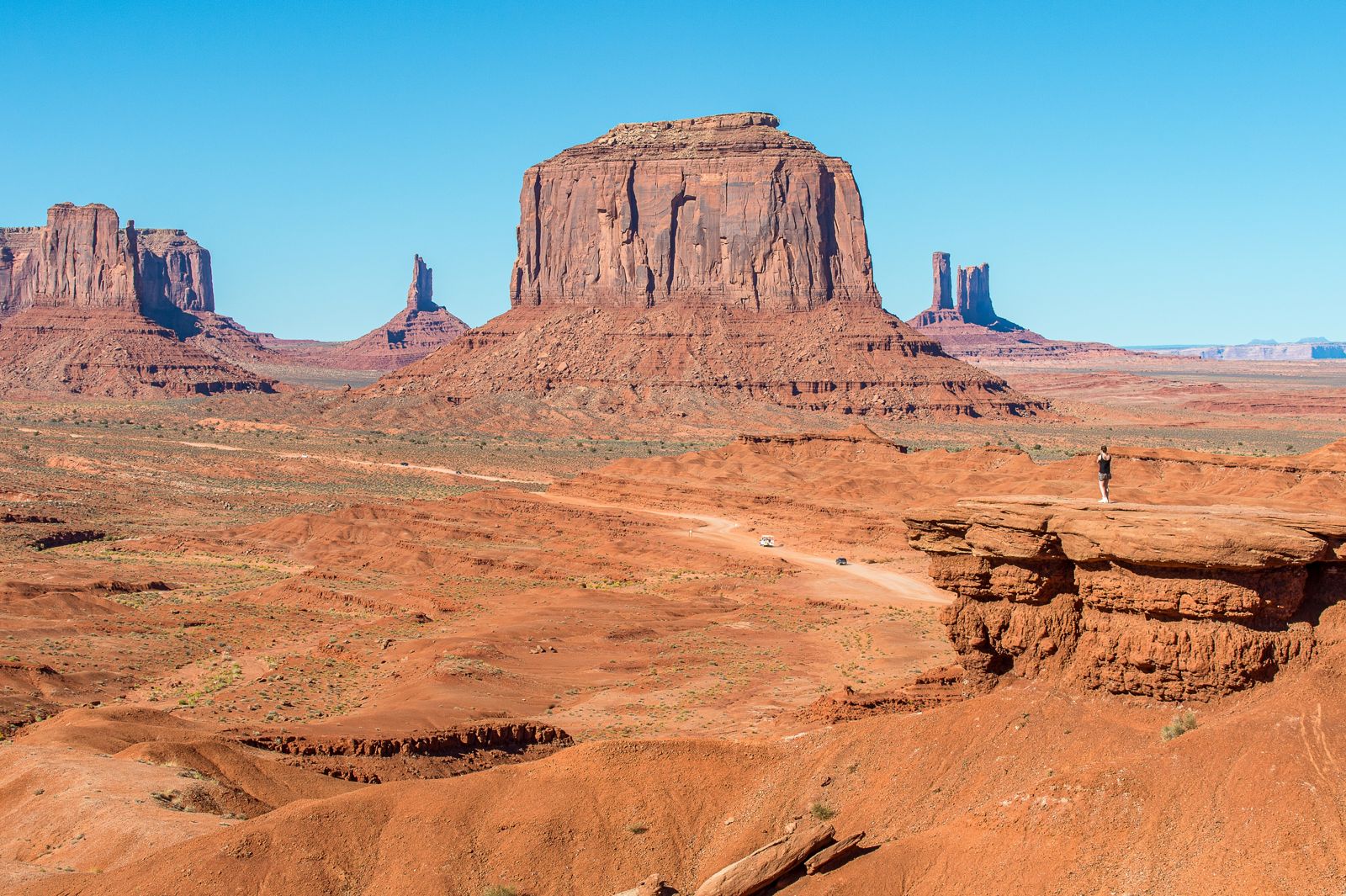
John Ford’s Point is a viewpoint on the Valley Drive, named for the director whose films made the view famous. Visit Utah lists it among the park’s celebrity monuments, alongside the Mittens, Three Sisters, Totem Pole, Yei Bi Chai and Ear of the Wind.
To reach it, you enter Monument Valley Navajo Tribal Park and drive or ride the 17-mile loop road. The park describes the road as all natural, a dirt road with very rough terrain and deep sand, and says an SUV or truck is preferable; motorcycles are not allowed. Visit Utah says most people spend about three hours on the loop, and recommends a high-clearance vehicle.
Along the loop road, Navajo vendors sell hand-crafted jewelry and crafts, and the park encourages visitors to buy direct from the artisans. Photographs of people need their permission first, and the park asks that nobody climb on the monuments, which are sacred to the Navajo.
The formations you know from the screen
Even people who have never been to Monument Valley know its outlines. The best-known include:
- The Mittens: West and East Mitten Buttes, the pair seen from the visitor center. Visit Utah calls them conspicuous 1,000-foot buttes.
- Merrick Butte: the butte that completes the classic panorama from the visitor center.
- Three Sisters, Totem Pole and Yei Bi Chai: among the named monuments Visit Utah lists for the park.
- Ear of the Wind: a landmark the park says can only be reached on a guided tour.
- Mesas and buttes with old names: Hunts Mesa, Eagle Mesa, Sentinel Mesa, Brighams Tomb, Castle Rock, Stagecoach, Big Indian, Rain God Mesa, Spearhead Mesa, Mitchell Mesa, Mitchell Butte, Gray Whiskers, Elephant Butte and Camel Butte.
Hunts Mesa, like Mystery Valley, is accessible only by guided tour. Several of these places sit on routes the self-drive loop does not reach.
Why the buttes look the way they do
The landscape that made Ford’s career was made by erosion. The Navajo Parks and Recreation Department explains that the valley was once a lowland basin, where sediment eroded from the early Rocky Mountains was laid down layer upon layer over hundreds of millions of years. A slow, gentle uplift raised those horizontal layers one to three miles above sea level, turning the basin into a plateau. For the last 50 million years, wind and water have cut into it, stripping away soft rock and leaving the hard rock standing. Visit Utah says the formations were sculpted over 300 million years, and that they are still slowly eroding.
The buttes show three main layers:
- Organ Rock Shale at the base.
- De Chelly Sandstone in the middle.
- The Moenkopi Formation on top, capped by Shinarump Conglomerate.
The red comes from iron oxide in the weathered rock, and the valley floor lies 5,000 to 6,000 feet above sea level. The sandstone formations rise 400 to 1,000 feet above it, which is why they read so clearly against the sky in a wide-screen shot.
After Ford: from Leone to Forrest Gump
Other directors followed. Sergio Leone shot Once Upon a Time in the West (1968) here; filmed in 1967, it was the first Spaghetti Western shot outside Europe. Gore Verbinski brought The Lone Ranger (2013). Visit Utah notes that the valley has been the backdrop to many Hollywood movies and television shows, beginning with several John Wayne films including Stagecoach in 1939, and including Forrest Gump in 1994.
The road in has its own screen career. Visit Utah says the stretch of U.S. 163 that climbs out of the San Juan River gorge toward the valley has been memorialized in many films over the years, with views that turn the windshield into an oversized, moving postcard.
Forrest Gump Point
In Forrest Gump, the 1994 Oscar-winning film starring Tom Hanks, Forrest runs back and forth across the country for three years, two months, 14 days and 16 hours. He finally stops on U.S. 163 with Monument Valley behind him, turns to the crowd of followers who have run with him, and says he is going home. Visit Utah places the spot around mile marker 13 on U.S. 163, on the Utah side, looking south toward the valley.
Now known as Forrest Gump Point, and nicknamed Forrest Gump Hill, it has become a place where fans re-create the scene. Visit Utah says it is easy to find, because there will likely be a dozen cars parked at the pullout by the sign.
What you need to know:
- Where: U.S. 163, around mile marker 13, north of the Utah-Arizona line. Visit Utah gives GPS coordinates of 37.101445, -109.990812.
- Cost: none; it is a roadside pullout, not part of the tribal park.
- Light: at sunrise the formations in the distance are lit from the front; at sunset the sun drops behind them, giving silhouettes.
- Safety: this is a highly trafficked highway, and Visit Utah warns there have been past injuries and fatalities. Take photos from the shoulder only, never from the middle of the road, and drive slowly as you approach.
The classic photo is taken looking down the center line, which is exactly where you should not stand. A longer lens from the shoulder gives the same view without the risk.
U.S. Route 163: the road in
U.S. Route 163 is a 64-mile highway that runs north from U.S. 160, south of Kayenta, Arizona, through Monument Valley to U.S. 191 at Bluff, Utah. Its southern 44 miles are within the Navajo Nation, it was designated in 1970, and it forms part of the Trail of the Ancients, a National Scenic Byway.
Coming from the north, Visit Utah’s route description is the best way to picture it. From Mexican Hat you cross the San Juan River into the Navajo Nation; after 21 miles on U.S. 163 you reach the turnoff for the tribal visitor center, and from there it is 4 miles to the park. Forrest Gump Point lies on that stretch. Mexican Hat itself appears in The Searchers, and the visitor center and Valley Drive are on the Arizona side of the state line.
Goulding’s today
The trading post that started it all still stands. Goulding’s Trading Post was added to the National Register of Historic Places on October 20, 1980, and the building is now the Goulding’s Trading Post Museum. In November 2023 the Navajo Nation bought Goulding’s Lodge for $59.5 million, and Goulding’s now describes itself as continuing its legacy under Navajo Nation ownership.
For film fans, the museum is the natural first stop: it is where the Hollywood story began. The Utah Film Trail, promoted by Visit Utah, also uses physical markers to guide travelers to real-world film locations around Utah.
A film-locations day
The film sites sit close enough together to see in one long day, if you plan around the light and the park’s hours.
- Early morning: Forrest Gump Point, when the sunrise lights the formations from the front and traffic is light. Pull well off the road.
- Mid-morning: Goulding’s Trading Post Museum, on the Utah side, where the Hollywood story began.
- Late morning to afternoon: the tribal park. Start at the visitor center, with the Mittens and Merrick Butte in front of you, then drive the Valley Drive to John Ford’s Point. Allow about three hours, and check the last entry time for the loop, which in winter is 2:30 p.m.
- Late afternoon: a guided tour with a Navajo operator to reach places beyond the loop, or a return to the viewpoint for sunset.
Remember that the Navajo Nation observes daylight saving time while most of Arizona does not, so in spring and summer the park’s clock runs an hour ahead of Page and Flagstaff. If you are booking a timed tour, confirm which time it is quoted in.
Visiting the film locations respectfully
Monument Valley is Navajo land, and the film sets were always someone’s home. A few rules apply on top of the usual road-trip common sense:
- Permits for commercial shoots: the park requires a Special Use Permit for photography, filming, weddings and painting beyond personal snapshots.
- No drones: drones are prohibited on the Navajo Nation, however tempting the aerial shot.
- People: ask permission before photographing Navajo people, and keep out of residential areas.
- Stay on the route: keep to the Valley Drive or go with a licensed Navajo guide; most backcountry and off-road travel is prohibited without one.
- No climbing: the buttes and monuments are sacred, and climbing is prohibited.
A guided tour is the easiest way to see the film locations beyond the loop. Guided tours of the park, led by local Navajo guides, run by vehicle and on horseback, and they reach places such as Ear of the Wind and Hunts Mesa that drivers cannot. Our tours page lists the options, and our article on Monument Valley and the Navajo Nation tells the longer story of the valley behind the films. For the best light and season for photographs, see our guide to Monument Valley weather.
Frequently asked questions
Where is Forrest Gump Point?
On U.S. Route 163 in Utah, around mile marker 13, looking south toward Monument Valley. Visit Utah gives GPS coordinates of 37.101445, -109.990812. It is a free roadside pullout outside the tribal park.
Is Forrest Gump Point safe?
Only if you stay off the road. Visit Utah warns that the highway is heavily trafficked and that there have been injuries and fatalities. Park well off the road and take photos from the shoulder.
Where is John Ford’s Point?
Inside Monument Valley Navajo Tribal Park, on the 17-mile Valley Drive. You need to pay the park’s entry fee and drive the loop or join a tour to reach it.
What movies were filmed in Monument Valley?
John Ford’s Stagecoach (1939), My Darling Clementine (1946), Fort Apache (1948), She Wore a Yellow Ribbon (1949) and The Searchers (1956), then Once Upon a Time in the West (1968), Forrest Gump (1994) and The Lone Ranger (2013), among many others.
Who brought Hollywood to Monument Valley?
Harry and Mike Goulding, who ran the trading post near the valley. During the Great Depression they went to Hollywood with $60, and Harry’s photographs helped persuade John Ford to film Stagecoach there.